
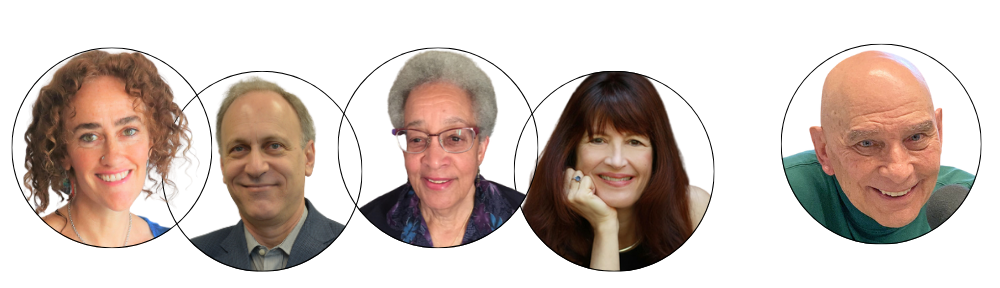
From left to right:
Keynotes: Clare Johnson, PhD, Ken Paller, PhD, Loma K. Flowers, MD, Diane Hennacy, MD
Invited Speaker: G. William Domhoff, PhD
Keynotes
Clare Johnson, PhD
Healing Dreams & The Joy Factor: Exploring Dream Body Intelligence
From Ancient Greek dream incubation rituals to today’s science-backed lucid dream therapies, Dr. Johnson presents a road map of how dreams can heal and sustain our physical & psychological health. She integrates sleep science and clinical findings with original techniques built on her doctoral research.
Drawing on her Prana Dream Body Hypothesis (2017), Johnson proposes a multi-sensory kinesthetic simulation model of how non-lucid and lucid dreams may support physical healing. She references work with paraplegic clients and injured athletes to illustrate both the boundaries and successes of this approach.
Johnson illuminates the mechanisms of psychological dream healing and lucid interventions for PTSD trauma resolution, grief processing, and maintaining mental health. She emphasizes the “joy factor” – how euphoric dream states replenish the dreamer, creating an optimal mindset for transformation, healing, and ongoing vibrant wellness.
Dr. Clare Johnson is an internationally known lucid dream pioneer. Former President of the International Association for the Study of Dreams, in 2006 she became the first person in the world to do a PhD on lucid dreaming as a creative tool. Her eight books include The Complete Book of Lucid Dreaming, The Art of Transforming Nightmares, Dream Therapy, and Elixir of Sleep. Clare offers ocean retreats in Hawaii and Portugal to help people unlock the genius of their sleeping intelligence. She runs a successful online school offering video classes, live workshops, and guided lucid dream meditations, and she hosts the Sleep & Deep Lucid Dreaming podcastwww.DeepLucidDreaming.com
Ken Paller, PhD
The Science Behind Enhancing the Value of Sleeping and Dreaming
Ken is a cognitive neuroscientist interested in dream research. His laboratory group made early progress in studying memory reactivation during sleep. Unconscious memory reactivation may be important not just for improving memory storage, but also for dreaming, creativity, and problem-solving. In many of his recent studies, dream content was strategically modified using sounds during REM sleep that were presented quietly to avoid disturbing sleep. His current research is also exploring intentional dreaming within advanced Tibetan-Buddhist contemplative practice (so-called Dream Yoga). He also helped set up a sleep lab in a monastery, taught neuroscience to monastic scholars, and trained them in the scientific investigation of sleep and dreaming.
Sleep is critical not only for its restorative benefits but also for the memory reactivation that occurs covertly. Corresponding changes in the brain help to make memories available when needed. Our habits of overnight memory reactivation influence dreaming and our psychological well-being upon awakening. Even though overnight memory reactivation may seem beyond volitional control, it can be strategically modified to seek various benefits.
Loma K. Flowers, MD
Dreams: The Highway to Emotional Health
Dr. Flowers will explore using dreams to maintain and promote your emotional health through insight into facts, feelings and actions when interpreted using Delaney’s Dream Interview [DI] technique. She will briefly review this technique to illustrate the dynamic clarity dreams reveal through the plot, emotions and facts known to the dreamer about the images in the dream. Using any new insight as a metaphor for a waking life issue, dreamers can consider the implications for action derived from their insight. Any responsive actions can address prevention, troubleshooting or effective repairs to maintain and sustain an emotionally healthy life.
Dr. Flowers earned her medical degree from the Case Western Reserve University School of Medicine. She is actively engaged in education, previously serving as a voluntary Clinical Professor of Psychiatry at UCSF, where she has been honored with esteemed teaching accolades. In 1984 she became the first Chairman of the Board of ASD, and in 1988, her talk at the ASD meeting in Ottawa, Canada, “The Morning After: A Pragmatist’s Approach to Dreams” was accepted by The Psychiatric Journal of the University of Ottawa. It introduced the integration of Delaney’s dream interpretation technique, dream interviewing [DI], with psychotherapy into peer review journals. Collaborating with Delaney for over ten years as the Delaney & Flowers Center for the study of dreams, they taught private Brief Intensive courses and workshops, including at ASD. Flowers’ subsequent peer review articles addressed various applications of DI insights to, e.g., substance abuse recovery and psychosomatic illnesses. Two book chapters covered training patients and psychiatrists in the use of DI. Dr. Flowers’ professional interests coalesced in 1994 with the development of an emotional competence [EC] curriculum that includes dreams as a powerful interna lresource. Currently, she consults with individuals and groups, on training new generations of clinicians in DI and students of all backgrounds in EC. She writes about EC. “Catching your Feelings, Skills to direct your emotions into constructive action” includes DI instructions and was self-published in 2025, KDP Amazon. Notably, she holds the national distinctions of being an APA Distinguished Life Fellow and recipient of the 2019 Solomon Carter Fuller Award.
Diane Hennacy, MD
Reality as a Construct: Lessons from Dreams, Savants, and Psychedelic States
Diane Hennacy (Powell), MD, is a Johns Hopkins trained neuropsychiatrist and former Harvard faculty member who has become a leading theoretician about consciousness and whose experimental research on autistic children was featured in the popular podcast “The Telepathy Tapes.”
Dreams, psychedelic journeys, and savant phenomena—such as spontaneous mathematical insight, perfect musical recall, and knowledge without conventional learning—have all been associated with access to information that appears to transcend ordinary sensory input, linear time, and personal memory. These phenomena offer a window into how reality may be perceived when neural filtering is reduced and invite a reexamination of fundamental assumptions about consciousness, time, and identity. This presentation opens a contemplative inquiry into what these states reveal about the nature of reality and suggests that the brain may not generate consciousness, but instead may function as a receiver that filters and tunes awareness within a broader field of information. Dr Hennacy explores these concepts through the lens of her work with nonspeaking autistic savants who report telepathy and other forms of extrasensory perception and seem to naturally bridge waking consciousness and dreamlike modes of knowing.
Invited Speakers
G. William Domhoff, PhD
Interweaving Dreams, Sleep, and Consciousness: A New Synthesis
G. William Domhoff is a Distinguished Professor Emeritus at the University of California, Santa Cruz. He is the author of The Neurocognitive Theory of Dreaming (2022), which won the American Association of Publishers; 2023 Prose Award for the best book relevant to Clinical Psychology and Psychiatry, and Dreams, Sleep, and Consciousness: Interweaving the Neurocognitive Theory of Dreaming with a New Theory of Sleep and a New Theory of Consciousness (2026).
This talk weaves together the neurocognitive theory of dreaming, the adaptive inactivity theory of sleep, and the multistate hierarchical model of consciousness. These recent theories were developed separately and independently by three psychologically trained empirical researchers, who did not construct their theories until late in their careers. All three theories build on a combination of neuroimaging, lesion, and developmental studies, which led to many unexpected findings and conclusions.